Why Lovable Sites Don't Show Up on Google (And How to Fix It)
.webp)
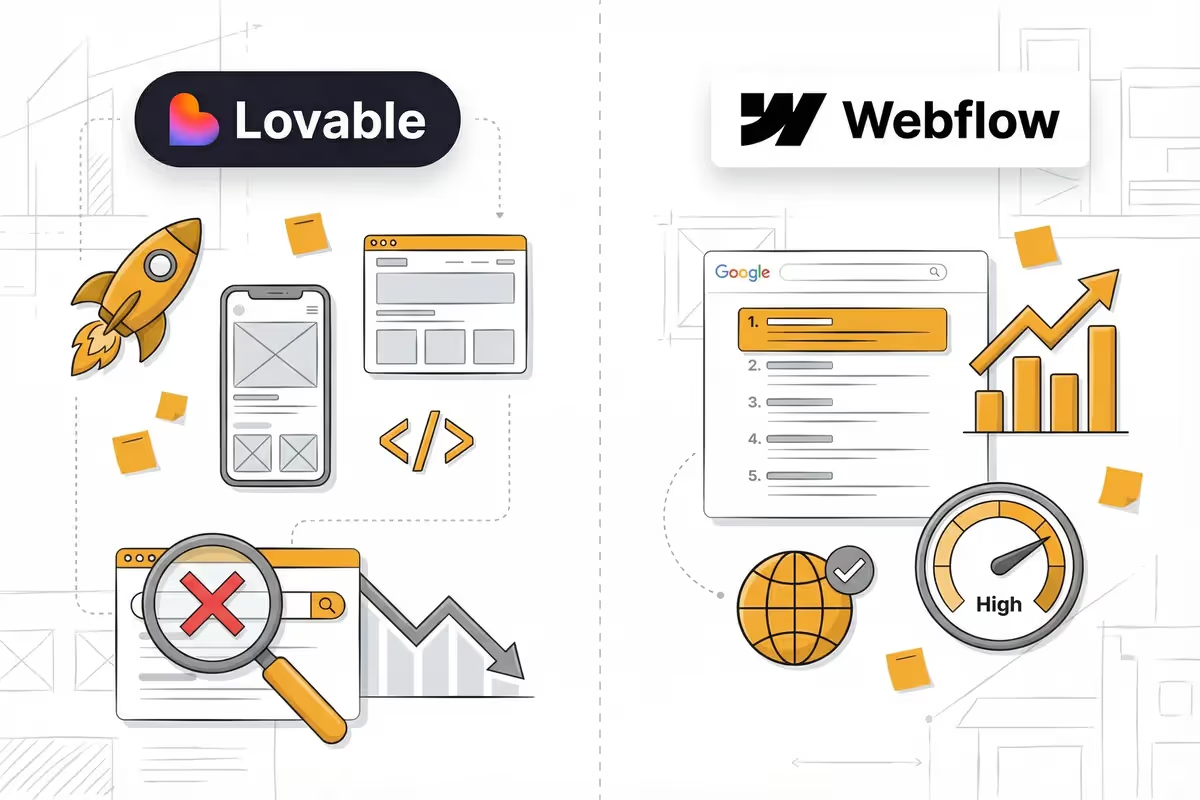
Table of content

Overview:
Lovable SEO is broken out of the box, and most founders don't find out until they've already launched. You built something that looks great, works well, and does exactly what you pitched to your first users. But when you search for it on Google, nothing shows up.
The problem isn't your content or your domain authority. It's how Lovable builds your app at the platform level. Every Lovable project ships as a client-side rendered React single-page application, and that architecture has a fundamental conflict with how search engines crawl and index the web.
This article breaks down exactly why your Lovable site is invisible to Google and AI search engines, what your real options are for fixing it, and which approach makes sense depending on what you're building.
Fast Lane
- Lovable SEO: Why Your Site Isn't Showing on Google
- What Google Actually Sees When It Crawls a Lovable App
- The AI Search Problem: It's Worse Than Google
- Three Ways to Fix Lovable SEO
- When Lovable SEO Doesn't Matter
- Lovable SEO Checklist You Can Do Today
- Lovable Is for Apps, Not Websites: Choosing the Right Platform
- Getting Your Lovable Site to Rank: What Comes Next
TL;DR
- Lovable builds every project as a client-side rendered React SPA, which means search engines receive an empty HTML shell when they crawl your pages.
- Google can eventually render JavaScript but takes up to 9x longer to index JS-heavy pages compared to static HTML.
- AI search engines like ChatGPT, Perplexity, and Claude don't execute JavaScript at all, making your Lovable site completely invisible to them.
- Your three fix options are: export to GitHub and add proper SSR, use a prerendering service, or optimize what you can within Lovable's limitations.
- Not every Lovable project needs SEO. Internal tools, SaaS dashboards, and apps behind login walls don't need organic traffic.
- Lovable is a web app builder, not a website builder. If your project is a marketing site, content site, or anything that depends on organic traffic, a platform like Webflow is a better foundation from day one.
Lovable SEO: Why Your Site Isn't Showing on Google
Lovable uses React with Vite to build every project as a single-page application with client-side rendering. This means your entire app loads from one HTML file, and JavaScript handles all the routing, content rendering, and page transitions in the browser. For users, this creates a fast and smooth experience. For search engines, it creates a serious problem.
When Google's crawler visits a traditional website, it receives a complete HTML document with all the text, headings, meta tags, and links already in place. It reads the content, understands what the page is about, and indexes it immediately.
When that same crawler visits a Lovable site, it receives a nearly empty HTML file. The actual content doesn't exist in the document. There's only a reference to a JavaScript bundle that the browser needs to download, parse, and execute before anything appears. Google can eventually process this JavaScript through a separate rendering service, but it's a second step that adds significant delay.
This isn't a bug in your Lovable project. It's a platform-level architectural choice. You can't change it through prompts, settings, or code modifications inside the Lovable editor. Every project built on Lovable has this same limitation, and it directly impacts whether your site appears in search results.
What Google Actually Sees When It Crawls a Lovable App
To understand the problem clearly, it helps to see what your Lovable app looks like from Google's perspective. When the crawler hits your homepage, the raw HTML response looks something like this: a basic document with a title tag, a single empty div element, and a script tag pointing to your JavaScript bundle. That's it. No headings, no paragraph text, no product descriptions, no calls to action. Just a shell waiting for JavaScript to fill it in.
Google's indexing process works in two phases. The first phase is the initial crawl, where the bot fetches your HTML and tries to extract content and links. For a Lovable site, this phase finds almost nothing useful. The second phase is the rendering queue, where Google sends JavaScript-heavy pages to a headless Chrome instance to execute the scripts and see what content actually appears. According to research cited by developer Jan-Willem Bobbink, this rendering phase takes approximately 9x longer than indexing static HTML pages.
That delay matters. Google has a crawl budget for every site, which determines how many pages it will process and how often. When your pages require extra rendering resources, Google processes fewer of them. A small Lovable site might wait weeks instead of days for indexing. A larger site might have pages that never get rendered at all.
Even when Google does render your JavaScript, the results aren't always accurate. Dynamic content, conditional UI elements, and client-side routing don't always produce the same output a real user sees. Pages that rely on API calls or user state can end up partially indexed or indexed with wrong information.
📌 Pro Tip: You can see exactly what Google sees by using the URL Inspection tool in Google Search Console. Request indexing for any page and check the "View Crawled Page" screenshot. If it's blank or missing content, you've confirmed the CSR problem firsthand.
The AI Search Problem: It's Worse Than Google
Google at least attempts to render JavaScript. AI search engines don't. ChatGPT's web crawler (OAI-SearchBot), Perplexity's bot, and Anthropic's ClaudeBot all fetch your page's raw HTML and work with whatever they find. None of them execute JavaScript. If your content only exists after JS renders in the browser, these crawlers see nothing.
This matters more than most founders realize. AI-powered search is growing fast, and being visible in tools like ChatGPT, Perplexity, and Google's AI Overviews is becoming a real traffic source for businesses. If your Lovable site is invisible to these systems, you're missing an entire channel that your competitors with traditional websites are already capturing.
The same problem hits social media sharing. When someone pastes your Lovable URL into LinkedIn, Twitter, or Slack, those platforms send a crawler to fetch Open Graph meta tags for a link preview. Those crawlers don't execute JavaScript. The result is a broken preview card with no title, no description, and no image.
Structured data has the same issue. Even if you add JSON-LD schema markup through Lovable's code, structured data added through client-side JavaScript is invisible to most AI crawlers. Your FAQ schema, product schema, and organization schema won't generate rich results if they only exist after JS execution.
Is Your Lovable Site Invisible to Google?
We'll audit your Lovable project, identify exactly what Google can and can't see, and recommend the right fix for your situation.
Get a Free SEO AuditThree Ways to Fix Lovable SEO
There's no single right answer here. The best approach depends on how critical organic traffic is to your business, your budget, and your technical comfort level. Here are your three real options, ranked from most effective to most accessible.
Option 1: Export to GitHub and Add Server-Side Rendering
This is the most effective fix and the one that gives you complete control. Exporting your Lovable project to GitHub gives you the full React codebase, which you or a development team can then migrate to a framework that supports server-side rendering, like Next.js. With SSR, your server generates complete HTML for every page before sending it to the browser. Search engines and AI crawlers receive fully rendered content on the first request, with no JavaScript execution required.
The trade-off is that this requires development work, and once you migrate away from Lovable's editor, you can no longer use the platform to make changes. This is a one-way door. But for any project where organic search is a primary growth channel, it's the approach that actually solves the problem rather than working around it.
Option 2: Use a Prerendering Service
Prerendering services sit between your Lovable site and search engine crawlers. When a bot requests a page, the service intercepts the request, renders the JavaScript in a headless browser, and serves the fully rendered HTML back to the crawler. Your actual users still get the normal client-side experience. Tools like Prerender.io and Hado SEO offer this as a managed service that you can set up without modifying your Lovable code.
This is a solid middle ground. You keep working in Lovable, your site becomes crawlable, and you don't need to hire a developer. The trade-off is recurring cost (typically $9 to $50 per month depending on the service and page volume) and the fact that you're adding a dependency. If the prerendering service goes down or changes pricing, your SEO is affected. It also doesn't solve the social sharing problem for all platforms, though many prerendering services do handle Open Graph tags.
Option 3: On-Page Optimization Within Lovable
If exporting or prerendering isn't feasible right now, you can still improve your situation within Lovable's limitations. Lovable's official documentation recommends setting up a custom domain, submitting your site to Google Search Console, and adding per-page meta tags through the Lovable editor. These steps won't solve the fundamental CSR issue, but they give Google more signals to work with during the rendering phase.
Think of this as damage reduction, not a fix. You're making it easier for Google to process your site when it does get around to rendering the JavaScript, but you're not eliminating the delay or the risk of incomplete rendering. For AI search engines and social sharing, this approach offers minimal improvement since the core problem remains: no JavaScript execution means no content.
⚠️ Warning: Be cautious with "SEO plugins" or prompt-based SEO fixes that claim to solve Lovable's indexing issues. If the solution doesn't address the fundamental client-side rendering architecture, it's not actually fixing the problem. Meta tags added via JavaScript still require rendering to be seen by crawlers.
When Lovable SEO Doesn't Matter
Not every Lovable project needs to rank on Google. This is something most articles about Lovable SEO skip entirely, but it's worth addressing because the real issue isn't how to fix Lovable's SEO. It's whether you're using the right tool for what you're building.
Lovable is a web app builder. It's designed for interactive products like SaaS dashboards, internal tools, admin panels, booking systems, and anything behind a login wall. For these use cases, organic search traffic is irrelevant. Your users access the app through direct links, your main marketing site, or an invite. Lovable's client-side rendering delivers exactly what matters here: a fast, responsive application experience.
The same applies to MVPs in early validation. If you're testing an idea with a small group of users through direct outreach, paid ads, or social media, SEO isn't your acquisition channel yet. Build fast in Lovable, validate your concept, and invest in SEO infrastructure once you've confirmed product-market fit.
But here's where founders get stuck: they use Lovable to build something that is actually a website. A landing page, a marketing site, a content-driven business, a blog, a directory, a portfolio. These projects live and die by organic traffic. Strangers need to discover them through search. And Lovable's architecture fundamentally works against that goal.
If what you're building is a website that needs to attract visitors from Google, Lovable isn't the right platform for it. A purpose-built website platform like Webflow gives you server-rendered HTML, clean semantic markup, built-in sitemap generation, full control over meta tags and structured data, and native CMS functionality designed for content that ranks. There's no rendering delay, no JavaScript dependency for crawlers, and no workaround required. Your pages are indexable the moment they go live.
The distinction is simple: Lovable is for web apps, Webflow (or similar platforms) is for websites. Choosing the right tool from the start saves you from fighting an uphill SEO battle later.
Lovable Is for Apps, Not Websites: Choosing the Right Platform
This is the decision that saves you the most time and money: figuring out whether your project is a web app or a website before you start building.
If your project is interactive, data-driven, and accessed by logged-in users (a SaaS tool, a client portal, a booking platform, an internal dashboard) Lovable is an excellent choice. It lets you build fast, iterate quickly, and ship a polished product. SEO is irrelevant for these projects because your users aren't finding you through Google.
If your project needs to attract organic traffic (a business website, a landing page, a blog, a directory, a portfolio, an e-commerce storefront) you need a platform built for that purpose. Webflow is what we recommend and use for these projects. Every page renders as clean, server-side HTML that search engines index immediately. You get visual design control, a built-in CMS for content, automatic sitemaps, and full SEO tooling without a single workaround. We've seen sites go from invisible to ranking on page one within weeks of migrating from a JS-heavy app to a proper website platform.
Some founders need both: a public-facing website that ranks on Google and brings in leads, plus an app that serves those leads once they convert. The right approach is to build these as two separate products on the platforms designed for each job. Your website lives on Webflow, your app lives on Lovable, and each one does what it's built to do.
Lovable SEO Checklist You Can Do Today
Regardless of which fix path you choose, these steps improve your Lovable site's discoverability right now. Some are quick wins, others set the foundation for a proper SEO strategy later.
Start by connecting a custom domain. Lovable's default subdomain (yourusername.lovable.app) doesn't build any domain authority, and any links pointing to it are effectively wasted equity. A custom domain gives search engines a consistent identity to associate with your content and backlinks.
Submit your site to Google Search Console and request indexing for every important page individually. Don't wait for Google to discover your pages on its own. Manual submission pushes your pages into the rendering queue faster and gives you access to crawl reports that show exactly which pages Google has processed and which it hasn't.
Add unique meta titles and descriptions to every page through Lovable's settings. Even though these are injected via JavaScript, Google's rendering phase will pick them up. Make each title unique, include your target keyword, and keep descriptions under 155 characters. This is the bare minimum for communicating page relevance to search engines.
Generate and submit a sitemap. A sitemap tells Google which pages exist on your site and how often they change. Even if Google takes longer to render and index them, at least it knows they're there. Check how to improve your website's SEO for a deeper guide on the fundamentals.
Set up Open Graph tags for every page you plan to share on social media. While this won't fix the JS rendering issue for all crawlers, some platforms and prerendering services specifically look for OG tags. Having them in place means the moment you add a prerendering layer or migrate to SSR, your social sharing is immediately functional.
📌 Pro Tip: Test your Open Graph tags using LinkedIn's Post Inspector and Twitter's Card Validator. If the preview is blank, you've confirmed that social crawlers can't see your JS-rendered content. This is a quick litmus test for how all non-Google crawlers experience your site.
Getting Your Lovable Site to Rank: What Comes Next
If your Lovable project is a web app that doesn't need organic traffic, you're in good shape. Keep building. The on-page optimizations in the checklist above are worth doing regardless, but SEO doesn't need to be a priority.
If organic search matters to your business, you have a decision to make. A prerendering service can bridge the gap in the short term. Exporting to GitHub and adding SSR gives you full control. And if what you built in Lovable is actually a website that needs to rank, migrating to a platform designed for that — like Webflow — is the move that solves the problem at the root instead of working around it.
At Alanbagi, we work with founders who built in Lovable and need to figure out the right next step. Sometimes that means an SEO strategy layered on top of a code export. Sometimes it means building a proper marketing website on Webflow while keeping the Lovable app for what it's good at. Sometimes it means starting fresh on the right platform. We help you figure out which path fits your project and your budget — and the initial consultation is free.
Lovable is a powerful tool when you use it for what it's designed to do: build web applications fast. The SEO limitation isn't a flaw. It's a signal that your project might need a different foundation. The sooner you make that call, the less organic traffic you leave on the table.
References
- JavaScript SEO Basics (Google Search Central) – Official guide to how Google processes JavaScript-rendered content.
- SEO & GEO Best Practices (Lovable) – Official documentation on optimizing your Lovable project for search engines and AI discovery.
- Rendering on the Web (web.dev) – Google's breakdown of CSR, SSR, and prerendering with performance and SEO trade-offs.
Not Sure If Lovable Is the Right Fit for Your Project?
We'll review your project, tell you whether Lovable, Webflow, or something else makes sense, and map out the best path forward. No cost, no commitment.
Book a Free Consultation
FAQ's
Why doesn't my Lovable site show up on Google?
Lovable builds every project as a client-side rendered React SPA. Search engines receive an empty HTML shell instead of actual content. Google can eventually render the JavaScript, but it takes significantly longer and many pages may never get fully indexed.
Can I fix Lovable SEO without leaving the platform?
You can make improvements like adding meta tags, connecting a custom domain, and submitting to Google Search Console. But these are damage reduction, not a full fix. The fundamental client-side rendering issue remains, which means slower indexing and invisible content for AI search engines.
Is Lovable good for building websites that need SEO?
No. Lovable is designed for web applications like SaaS dashboards, internal tools, and apps behind login walls. If your project needs organic traffic from Google, a website platform like Webflow gives you server-rendered HTML that search engines can index immediately without workarounds.
Do AI search engines like ChatGPT and Perplexity index Lovable sites?
No. AI search crawlers like ChatGPT's OAI-SearchBot, Perplexity's bot, and Anthropic's ClaudeBot do not execute JavaScript at all. They only read raw HTML, so Lovable sites with client-side rendered content are completely invisible to AI search results.
What is the best way to fix Lovable SEO permanently?
The most effective permanent fix is exporting your Lovable project to GitHub and migrating to a framework with server-side rendering like Next.js. If your project is actually a website rather than a web app, the best move is building it on a purpose-built website platform like Webflow instead.