AI Lead Generation: What the Tools Can't Do Without You
.webp)
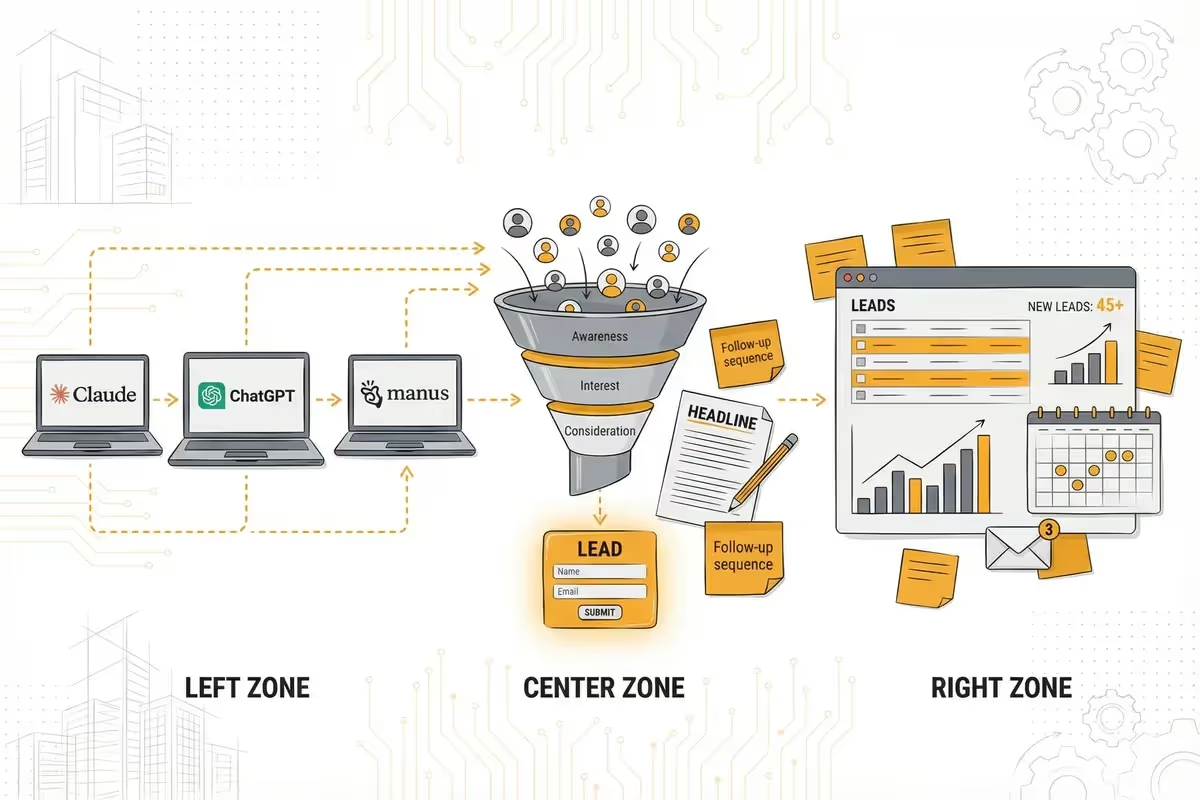
Table of content

Overview:
AI lead generation sounds like it should be simple. Plug in a tool, watch the leads roll in. But after building these systems for clients across multiple industries, we've learned the tools only get you halfway there. The other half? Strategy, design, and knowing which approach fits your business.
Most articles treat AI lead generation as one thing. It's not. We break it down into three distinct approaches, and most businesses only know about one of them. We're going to break down all three: organic content, paid ads, and cold outreach. Each uses a different set of tools, targets a different stage of buyer awareness, and requires a different kind of expertise to make it work.
Fast Lane — Quick Access
- The three approaches to AI lead generation
- Organic: SEO and content that brings leads to you
- Paid ads: Google, Meta, and the funnel that converts
- Cold outreach: Apollo, Claude, and finding your ICP
- The most important part: human management and prompting
- Where AI stops and expertise starts
- Why most businesses get this wrong
- How we can build this for you
TL;DR
- AI lead generation works through three channels: organic content, paid ads, and cold outreach. Each one requires different tools and a different strategy.
- For organic, we use Claude and the Ahrefs API for keyword research, then build content that ranks and converts. The human layer (rewriting, tone, conversion design) is what makes it work.
- For paid ads, we run Google Ads and Meta campaigns that direct traffic to conversion-optimized landing pages built with Lovable or GoHighLevel. The landing page is where most businesses lose their ad spend.
- For cold outreach, we use Apollo to find contacts and build lists, then Claude to draft personalized emails. The key is testing small batches against different ICPs before scaling.
- The real competitive advantage isn't the tools. It's having someone who knows what converts sitting between the AI and the send button.
Three Approaches to AI Lead Generation (And Why You Need More Than One)
Most articles about AI lead generation talk about it like it's one thing. It's not. There are three distinct approaches, each with its own timeline, investment, and skill requirements:
Organic lead generation uses AI to speed up SEO research and content creation. Leads find you through search. It's the slowest to start but builds compounding value over time. Six months in, your content is generating leads while you sleep.
Paid ads lead generation uses AI to optimize campaigns on Google and Meta, then directs traffic to high-converting landing pages and funnels. Leads come fast, but you're paying for every click. The ROI depends entirely on your landing page and funnel design.
Cold outreach lead generation uses AI to find contacts, build targeted lists, and draft personalized emails. You're reaching out directly to prospects who've never heard of you. It's the most direct path to conversations, but only works when you've nailed your ICP.
The businesses that generate the most leads? They don't pick one. They layer all three so they've got inbound traffic building, ads driving immediate conversations, and outreach filling the pipeline with exactly the right prospects.
📌 Pro Tip: If you're evaluating AI lead generation tools, stop comparing feature lists. Ask one question instead: "Which of these three channels fits my business right now?" A SaaS company with no organic presence needs content first. A service business with a proven offer needs ads and outreach. Start where you'll see results fastest.
Want to See What This Looks Like for Your Business?
We'll walk through your current setup, show you where the gaps are, and map out a lead generation system built around your services.
👉 Book a Free ConsultationOrganic: AI-Powered SEO That Brings Leads to You
This is the long game, and it's the one that compounds. You use AI to speed up keyword research and content creation. Then that content ranks, brings traffic, and converts visitors into calls and form submissions month after month without paying for each click.
The research stack
We use Claude to connect directly with the Ahrefs API for keyword research. Instead of manually pulling reports, we feed Claude a client's URL and their three closest competitors, and it comes back with keyword gaps, volume data, and difficulty scores organized by topic cluster. What used to take a full day of spreadsheet work now takes about twenty minutes.
We also use Manus (now part of Meta) for competitor intelligence. It crawls competitor sites, pulls their content structure, identifies what they're ranking for, and spots the topics they haven't covered. That's where the real opportunities hide.
Content creation with a human filter
Claude writes fast. It can produce a 2,000-word draft in minutes. But a draft isn't a published article. Every piece we publish goes through a human rewrite where we check the tone, add real client examples, strip out the AI patterns, and make sure the content sounds like it came from someone who's done the work.
We've seen what happens when businesses skip this step. The content reads like every other AI-generated blog post on the internet. Google's helpful content system catches it. Readers bounce. Zero leads.
Custom AI skills that run the process for us
Here's something we don't see anyone else talking about: we build custom skills on Claude that automate our entire SEO workflow. Our content strategy skill runs keyword research, competitor analysis, content calendar planning, article brief generation, and a pre-publish quality checklist, all in one process. It checks for AI writing patterns (missing contractions, em dash overuse, robotic sentence starters), verifies keyword placement isn't stuffed, scores every article against E-E-A-T signals, and flags issues before anything goes live.
We've honed this skill over dozens of articles. Every time we catch a pattern that hurts rankings or readability, it gets added to the checklist. The result is a repeatable process that produces consistently high-quality content at speed, without the quality drop-off that comes from trying to remember everything manually. We build these same kinds of custom AI workflows for clients who want their content operation to run like a system, not a guessing game.
Want Our SEO Strategy Built for Your Business?
We'll run the same keyword research, competitor analysis, and content planning process we use for our own site, built around your services and your audience.
👉 Book a Free Strategy CallThe organic timeline
Content typically takes 2-4 months to start ranking and driving traffic. That's not a weakness; it's a feature. By month six, you've got articles generating leads consistently without ad spend. By month twelve, your cost per lead from organic is a fraction of what it costs through ads. The compound effect is what makes this approach so powerful for businesses that can invest the time upfront.
Paid Ads: Google, Meta, and the Funnel That Converts
If organic is the long game, paid ads are the fast lane. You can have leads coming in within a week of launching a campaign. But here's the part most businesses learn the hard way: the ads aren't the problem. The landing page is.
How we run Google Ads campaigns
We structure campaigns around buyer intent, not just keywords. Someone searching "small business website cost" is in a different headspace than someone searching "web design agency near me." The first is researching. The second is ready to hire. Each one needs a different ad, a different landing page, and a different CTA.
We start with Maximize Conversions bidding to gather data, then shift to Target CPA once we've got enough conversion history to let the algorithm optimize. Most small businesses make the mistake of running broad match keywords with Smart Bidding from day one and wonder why they're getting clicks from people who'll never buy.
For service businesses, we also use Google's lead form assets. They put a short form directly inside the ad, pre-filled with the searcher's Google account info. On mobile, these convert significantly better than sending someone to a landing page that takes three seconds to load. The lead goes straight into the CRM pipeline.
Meta Ads for awareness and retargeting
Google captures people who are already searching. Meta (Facebook and Instagram) puts you in front of people who don't know they need you yet. And with Manus now under the Meta umbrella, the AI capabilities for ad targeting and audience building have gotten significantly sharper. We run two types of Meta campaigns for lead generation:
The first is a cold audience campaign using lookalike audiences built from existing client lists. We test 3-4 creative variations (usually short video or carousel) with direct response copy that drives to a landing page or lead form. Manus helps here too, pulling competitor ad data and audience insights that inform the targeting and creative strategy. The second is retargeting: anyone who visited the site, engaged with content, or started but didn't complete a form sees a follow-up ad with social proof and a stronger offer.
Meta's cost per lead is usually lower than Google's, but the lead quality is different. Google leads are actively searching for a solution. Meta leads are interested but haven't started shopping yet. Your follow-up sequence needs to account for that difference.
The landing page problem
This is where most ad spend goes to die. A business runs solid Google Ads, pays $15-30 per click for high-intent keywords, and sends that traffic to their homepage. Or worse, to a landing page with a vague headline, no social proof above the fold, and a CTA that says "Contact Us."
We build dedicated landing pages for every campaign using Lovable or GoHighLevel. Each page matches the ad's promise, speaks to one specific pain point, and has a single clear action: book a call, get a quote, or download a resource. The headline mirrors the search intent. Social proof sits above the fold. The form asks for the minimum information needed to qualify the lead.
Then we connect the funnel: form submission triggers a CRM entry, notification to the sales team, and an automated follow-up sequence. Calendly embeds handle direct booking for service businesses. The entire journey from ad click to booked call is automated and tracked so we can see exactly where leads drop off and fix it.
The paid ads timeline
Leads can start coming in within 48 hours of launch. But it takes 2-4 weeks of data to optimize. We typically run $50-100/day to start, gather conversion data, then scale what's working and kill what isn't. By week four, you should have a clear cost per lead and cost per booked call. If those numbers work for your margins, you scale. If they don't, we adjust the landing page, the offer, or the targeting before spending more.
Cold Outreach: Apollo, Claude, and Finding Your ICP
Cold outreach gets a bad reputation because most people do it badly. Mass emails to purchased lists with generic templates. That's spam, and it doesn't work. What does work is using AI to find the right people, write relevant messages, and test your way to the ICP that actually responds.
Finding contacts with Apollo
Apollo gives you access to a massive B2B contact database with filters for industry, company size, role, location, technology stack, and funding stage. Instead of guessing who might need your services, you build targeted lists based on real data.
We start by defining 3-4 ICP hypotheses. For a web design agency, that might be: construction companies with 10-50 employees and no website redesign in 3+ years, SaaS startups that just raised a seed round and need a marketing site, and professional services firms still running a template site from 2019. Each hypothesis becomes a separate Apollo list with different filters.
Apollo also tracks intent signals: job changes, company growth, technology installs, funding events. When a company in your ICP hires a new marketing director, that's a trigger. When they add a competitor's tool to their tech stack, that's another. These signals tell you when someone is most likely to need what you offer.
Drafting emails with Claude
Here's where AI earns its keep. We feed Claude the prospect's company data from Apollo (industry, size, tech stack, recent news) and have it draft personalized emails that reference something specific about the prospect's situation. Not "I noticed your company is growing" generic filler. Actual details: their current website's load time, a gap in their SEO coverage, a competitor who just launched a better site.
Claude drafts the email in three parts: a hook that shows you've done your homework, a bridge that connects their situation to a specific outcome, and a soft CTA that asks for a conversation rather than a commitment. We keep emails under 120 words. Nobody reads a cold email that's four paragraphs long.
But Claude doesn't send anything. Every email gets a human review. We check the tone, verify the personalization is accurate, and make sure it sounds like a real person wrote it. The fastest way to get flagged as spam is to send AI-generated emails that read like AI-generated emails.
The ICP testing framework
This is the part most businesses skip, and it's the most valuable part of the entire cold outreach process. You don't know which ICP will respond best until you test.
We send small batches: 50-75 emails per ICP hypothesis. We track open rates, reply rates, and most importantly, positive reply rates (not just "unsubscribe" or "not interested" replies). After two weeks, the data tells you which ICP segment has the highest engagement. That's the one you scale.
We've seen cases where a client was convinced their best prospects were mid-size agencies, but the data showed solo consultants replied at 3x the rate. Without testing, they'd have wasted months targeting the wrong audience. The test batches cost almost nothing in time or money compared to scaling the wrong ICP for six months.
📌 Pro Tip: Don't scale cold outreach until you've tested at least 3 ICP segments with 50+ emails each. The difference between a 1% and a 4% positive reply rate compounds massively at scale. A bad ICP at high volume just gets you flagged as spam faster.
Connecting outreach to your pipeline
Apollo integrates directly with most CRMs. Every email sent, every reply received, and every meeting booked flows into the same pipeline as your organic and paid leads. We set up sequences in Apollo so follow-ups happen automatically (day 3, day 7, day 14), but the initial email and any warm replies always get handled by a person.
The cold outreach timeline is the fastest of all three approaches. You can have conversations happening within the first week. But it takes 4-6 weeks of ICP testing to find the segment worth scaling. Once you've found it, you can predictably generate 10-20 qualified conversations per month from a well-tuned outreach machine.
The Most Important Part: Human Management and Effective Prompting
Every tool we've mentioned (Claude, Apollo, Ahrefs, Lovable, GoHighLevel) is available to anyone with a credit card. The difference between businesses that generate leads and businesses that generate noise comes down to one thing: how well a human manages the AI.
Prompting isn't typing a sentence and hoping
Effective prompting is a skill, and most people underestimate how much it matters. Telling Claude "write me a blog post about lead generation" gets you generic content that ranks nowhere. Telling Claude to analyze three competitors' keyword gaps, identify clusters with volume above 300 and difficulty below 40, then draft an article targeting a specific long-tail keyword with a conversion-focused structure, real client examples, and a tone that matches your brand? That gets you content that actually performs.
The same applies to every channel. Prompting Apollo's filters to find the right ICP segment takes someone who understands buyer personas, not just someone who can check boxes. Prompting Claude to draft a cold email that sounds personal requires feeding it specific prospect data and a clear framework, not a vague "make it friendly." Prompting Lovable to build a landing page that converts means giving it a wireframe informed by real conversion data, not just "make it look professional."
Managing AI like a team member
Here's how we think about it: AI is the fastest junior employee you've ever had. It works around the clock, never complains, and produces volume that no human can match. But it has zero judgment. It doesn't know when a keyword looks good on paper but won't convert. It doesn't know that the email it just drafted sounds pushy instead of helpful. It doesn't know the landing page headline is clever but unclear.
That's why every AI output in our workflow goes through a human review. We don't use AI to replace the strategist. We use it to give the strategist superpowers. The AI does the research, pulls the data, writes the first draft, and builds the first version. The human decides what's good, what needs reworking, and what gets scrapped entirely. That loop is where the quality lives.
The compounding effect of good prompts
When you invest time building proper prompts and workflows, the returns compound. Our SEO skill on Claude didn't happen overnight. We built it article by article, adding checks every time we caught an issue: a heading that sounded stuffed, a paragraph that read like AI wrote it, a CTA placed in the wrong spot. Now that skill runs automatically and catches problems before they go live. The same goes for our outreach templates, our ad copy frameworks, and our landing page structures. Each one gets sharper with use because a human is reviewing the output and feeding improvements back into the process.
Most businesses treat AI as a magic button. Press it and leads appear. The ones that actually succeed treat it as a tool that needs to be directed, managed, and continuously refined by someone who knows what good output looks like.
Where AI Stops and Expertise Starts
This is the section every listicle skips, and it's the most important one. It applies to all three approaches.
AI can research keywords. It can't tell you which ones your specific audience actually types into Google versus which ones look good on a spreadsheet. AI can generate a landing page. It can't decide whether your hero section should lead with a pain point or a result. AI can draft a cold email. It can't judge whether the tone will land with a CFO versus a marketing manager.
The design problem
Most AI-generated landing pages look fine at first glance. The layout is clean, the spacing works, the colors are reasonable. But "fine" doesn't convert. Converting requires understanding visual hierarchy: the visitor's eye needs to hit the headline, then the subhead, then the social proof, then the CTA, in that exact order. It requires knowing that a wall of text below the fold kills conversion rates even when the copy is good. These aren't things you learn from a prompt. You learn them from building and testing pages over years.
The tone problem
AI defaults to a tone that's polished, professional, and completely forgettable. Whether it's a blog post, an ad headline, or a cold email, AI output sounds like corporate brochure copy. The businesses that generate the most leads have a distinct voice. Direct, specific, occasionally blunt. You can prompt AI to adjust its tone, but someone still needs to know what the right tone is for your audience and your channel.
The strategy problem
AI can execute tasks within each channel. It can't tell you that your Google Ads budget would generate better ROI as cold outreach right now because your landing page isn't ready yet. It can't look at your cold email reply data and recommend pivoting your content strategy to target the ICP segment that's responding. It can't connect the dots across all three channels and decide where to invest next week's effort. That's a strategist's job.
⚠️ Warning: Running all three lead generation channels without a strategy connecting them is worse than running one channel well. You'll spread your budget thin, get inconsistent messaging across channels, and have no way to tell which channel is actually driving revenue. Start with one, prove it works, then add the next.
Why Most Businesses Get This Wrong
They buy the tools and skip the strategy. We see it across all three channels.
With organic, a business owner signs up for an AI content tool, generates twenty blog posts in a weekend, publishes them all, and wonders why Google didn't send a single visitor three months later. The content is technically correct but reads like everything else on the internet. Google's helpful content system catches it.
With ads, they run a solid Google Ads campaign, pay $20 per click for high-intent keywords, and send traffic to a generic homepage. The ad worked. The landing page didn't. They blame Google Ads.
With cold outreach, they buy an Apollo subscription, export 5,000 contacts, and blast the same template to everyone. Open rates crater, their domain gets flagged, and they conclude that "cold email doesn't work." It does work. Mass email doesn't.
The fix is the same across all three: put a strategist between the tools and the output. Someone who knows what good content looks like, what converts on a landing page, what makes a cold email get a reply, and how to connect the pieces so the lead journey makes sense from first touch to booked call.
If you're considering building a website that actually drives leads, take a look at how we built a lead-generating site for a construction company. It's the same philosophy: AI handles the speed, human expertise handles the strategy. And if you want to understand what a website redesign actually costs in 2026, we break that down too.
How We Build This for Your Business
We run this exact workflow for small businesses that want leads from their website, their ads, and their outreach but don't have the time or expertise to build the system themselves. You get the AI-powered speed across all three channels combined with the strategic layer that makes it actually work: conversion-focused design, content that sounds human, ads that target the right intent, and outreach that finds the right people with the right message. Check out our SEO and content services to see how the organic side fits together, or our lead generation services for the full system.
Ready to Build a Lead Generation System That Works?
We'll map out the keyword targets, ad campaigns, outreach sequences, and CRM pipeline for your business. One conversation to see the full picture.
👉 Book a Free ConsultationFAQ's
How much does AI lead generation cost for a small business?
It depends on the channel. Organic (SEO and content) costs $2,000-5,000 for initial setup plus ongoing production. Paid ads require $50-100/day minimum in ad spend plus landing page and funnel builds. Cold outreach with Apollo runs about $100-300/month for the tool plus time for email drafting and ICP testing. The real cost across all three isn't the tools, it's the strategy layer that makes them convert.
What's the fastest way to generate leads with AI?
Cold outreach is the fastest. Using Apollo to build targeted contact lists and Claude to draft personalized emails, you can have conversations happening within the first week. Paid ads with Google or Meta are next, with leads possible within 48 hours of launch. Organic SEO content is the slowest to start (2-4 months) but builds compounding value that generates leads without ongoing ad spend.
Can AI replace a marketing agency for lead generation?
AI can handle the production work across all three channels: keyword research, content drafts, ad copy, contact list building, and email drafting. But it can't replace strategic thinking. Knowing which ICP to target, how to structure a landing page for conversion, what tone resonates with your audience, and how to connect all three channels into a working pipeline still requires human expertise. Most businesses that try AI-only lead gen end up with content that doesn't rank, ads that don't convert, and outreach that gets flagged as spam.
How do you use Apollo and Claude for cold email outreach?
We use Apollo to build targeted contact lists filtered by industry, company size, role, and intent signals. Then we feed the prospect data into Claude to draft personalized emails that reference specific details about each prospect's situation. We test small batches (50-75 emails) against 3-4 different ICP hypotheses, track positive reply rates, and scale whichever segment responds best. Every email gets a human review before sending.
Should I use Google Ads or SEO for lead generation?
Both, but at different times. If you need leads now and have budget for ad spend, start with Google Ads targeting high-intent keywords with a dedicated landing page. If you're building for the long term, invest in SEO content that compounds over time. By month six, organic content generates leads without ad costs. The ideal setup layers both: ads for immediate pipeline, SEO for compounding growth, and cold outreach to fill gaps with targeted prospects.