Our previous site was built on Webflow, and it served us well. It had strong design and branding, smooth animations, and it was easy enough to edit. Webflow is a good platform, and we still recommend it for the right projects. But website building and management has entered a new era. AI now helps design, write, build and maintain a site, people find businesses through AI answers as well as Google, and every page has to be fast on a phone. So we did a full website redesign of alanbagi.com for that new era, the same way we do it for clients.
This website redesign case study covers the goals, the plan, and the results so far. It doesn't cover the step-by-step method, which is the work we do for clients. We'll keep adding results as the new site settles in.
Why we raised the bar
Webflow gave us a strong site. The new era let us go further:
- From fast to instant. Good load times weren't enough. We wanted top scores on Google's own speed test, on every phone.
- From editable to effortless. Updating a page or publishing an article should take minutes, so the site can always reflect our latest work.
- From Google-ready to AI-ready. People now ask AI chat assistants and Google's AI answers for recommendations. We wanted every page built so those tools can read and understand it.
- Built and managed the new way. AI now helps us design, write, build and update the site, with full control over speed, structure and search settings.
Our website redesign goals
We gave the redesign five goals, the same five we set for every client website redesign:
- Fast on every phone. Top scores on Google's own speed test.
- Easy to edit. Updating a page or publishing an article should take minutes.
- Built for Google and AI search. Clear structure, clean pages and content that answers real questions. (This is what our AI search optimization service does for clients.)
- Nothing lost. Every old address keeps working, so years of links keep working. Our website redesign SEO checklist covers why this matters.
- Built to turn visits into leads. Clear calls to action, working forms and proof on every page.
The redesign plan
We ran the project in clear stages, each one checked before the next began:
- Inventory. We listed every page, article and address the old site had, and every search query that brought people in.
- Design. A new look with motion and depth that still scores 97 to 100 for performance, checked on small phones, large screens and both Safari and Chrome.
- Content. Every service page, case study and article moved over and was tightened: clearer answers, plain language and a reason to get in touch.
- Testing. The new site ran on a private address for weeks while we compared it page by page against the old one.
- Switch-over. Email, client subdomains and every other service kept running while the main address moved to the new site in a single day.
The design: premium look, top speed scores
A site that looks good and a site that gets results are usually treated as a trade-off. Rich visuals slow pages down, and fast pages often look plain. Getting both is where design expertise matters most.
- A color system with a purpose. A deep, moving dark background with warm yellow and sky blue, used consistently so every page feels like the same brand and every call to action stands out.
- Frosted glass and depth. Cards and panels that look like frosted glass over living color, giving the site a premium, modern feel.
- Motion that explains. Each service has its own animated illustration that shows what we do at a glance, instead of a stock photo.
- Illustrated articles. Every blog article has its own custom cover, so the blog looks as considered as the home page.
- Details on every screen. Typography, spacing and motion tuned for small phones, large monitors, Safari and Chrome, with motion that calms down for visitors who prefer less of it.
Any template can add a gradient or an animation. Making them feel effortless, keeping them consistent across every page, and doing it all without slowing the site down takes design and front-end expertise. That balance is what we aim for on every site: a design that holds attention and makes it easy to get in touch.
Website redesign results so far
Speed
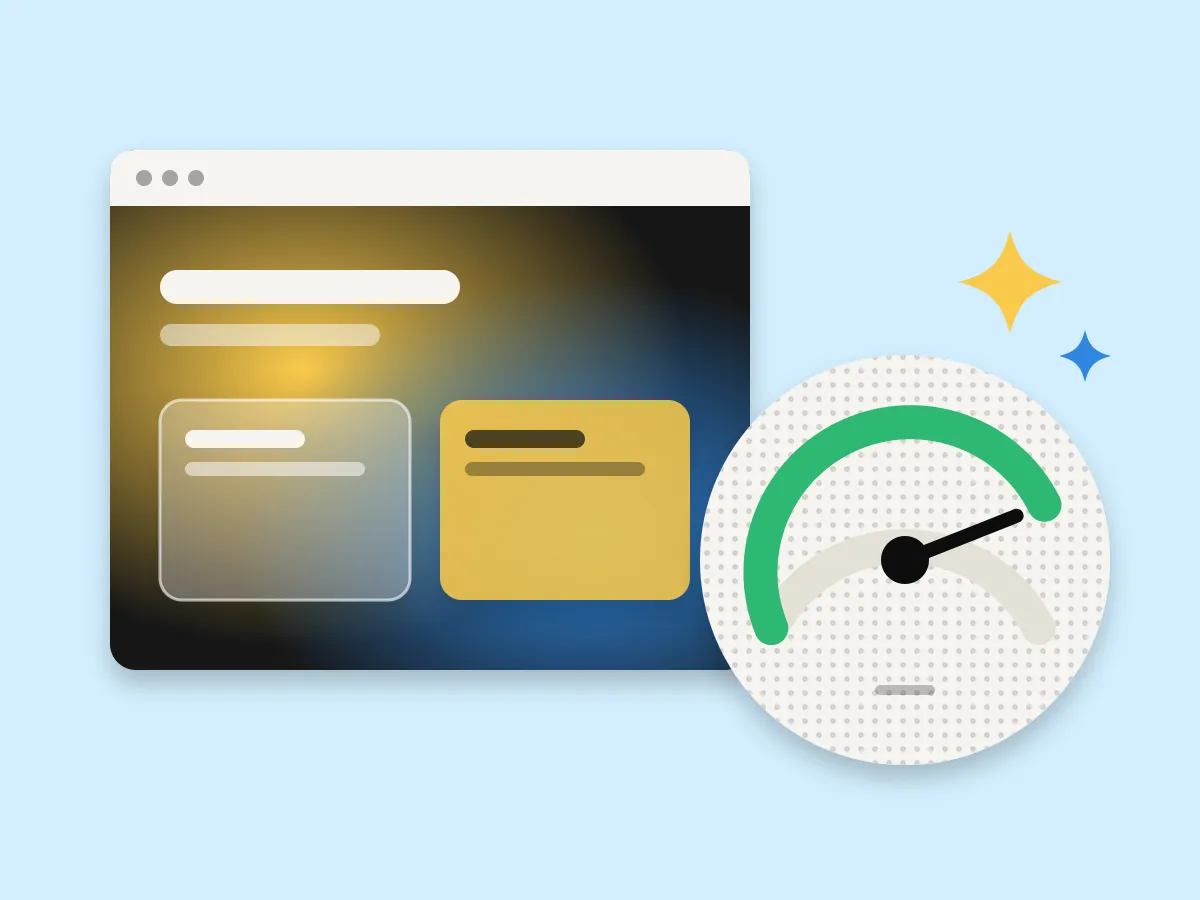
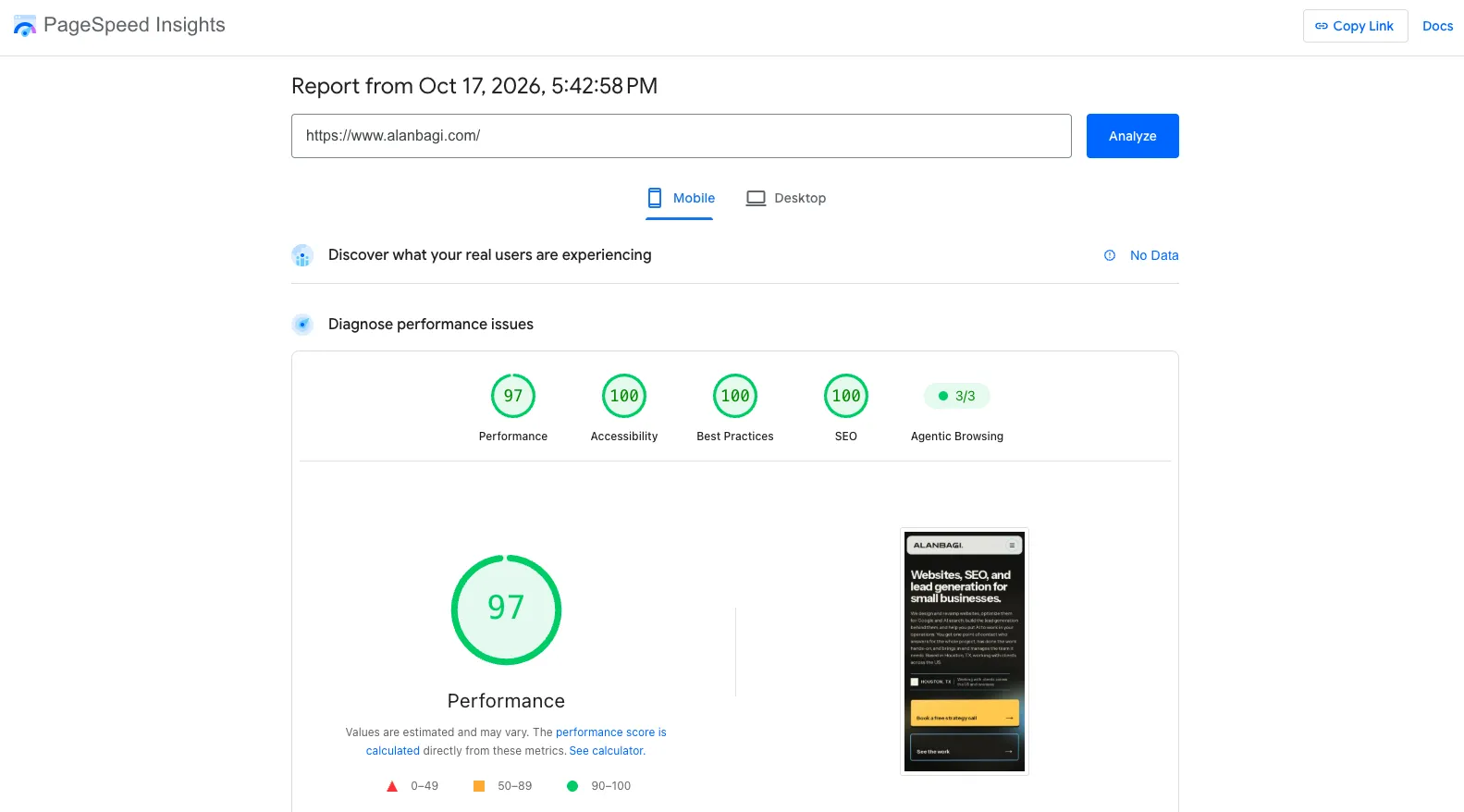
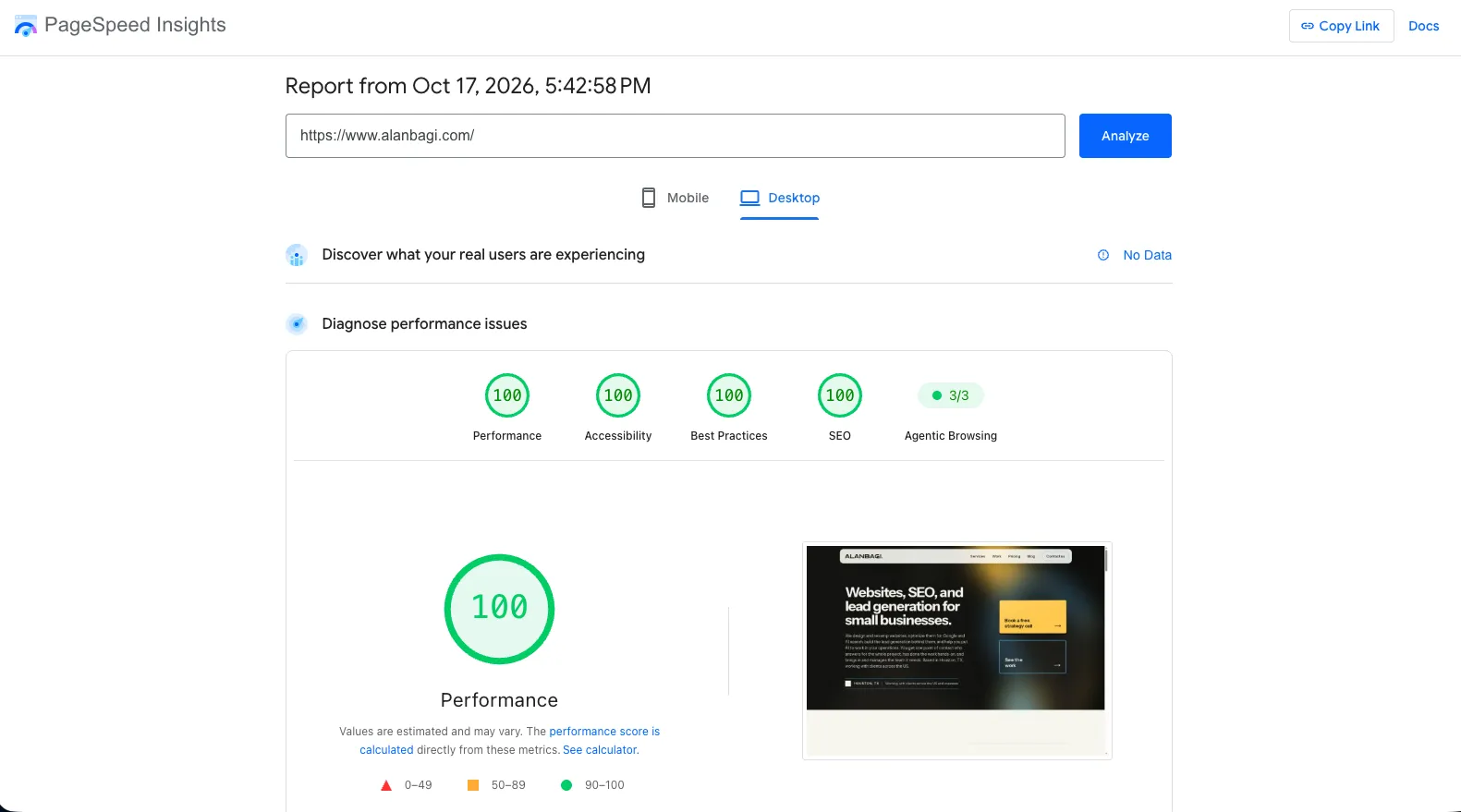
Google PageSpeed scores the new site 100 for performance on desktop and 97 on phone, and 100 for accessibility, best practices and SEO on both. It also passes all three of PageSpeed's Agentic Browsing checks.
Nothing lost in the move
The old site had 115 addresses that Google or other websites knew about. Every one of them still works: each page either loads at the same address or forwards in one step to its new home. A full check after the switch found zero broken links.
Indexed fast
Within three days of the switch, Google had read the new sitemap and found all 73 pages. We'll publish the traffic numbers here as they grow.
Ready for AI search
Each page is built so AI assistants can understand it: a clear answer near the top, structured information about the business and each service, questions and answers people actually ask, and a simple file that tells AI tools what's on the site.
Easy to edit
Pages and articles live in simple text files, so updating prices, swapping a case study or adding a new service page no longer needs a page builder.
Leads
Both forms on the site now send each inquiry straight to our inbox, with spam filtered out before it gets there. Lead results will be added here once we have a few months of data.
What this means for your website
If your site works but you know it could do more, a website redesign doesn't have to mean starting over or losing what you've built. The same approach works for a five-page local business site or a full company website:
- Keep everything that already brings you visitors.
- Make it fast, so people stay.
- Make it easy to update, so it stays current.
- Make it readable for Google and AI assistants, so people find you.
- Give every page a clear next step, so visits turn into inquiries.
Wondering what that costs? Our guide to website redesign cost in 2026 breaks it down, and our pricing page shows what we charge.
Want the same result for your website?
Tell us about your site and what isn't working. We'll tell you honestly what a rebuild would change, and what it would cost.
Results log
We'll update this section as the numbers come in.
| Date | Update |
|---|---|
| Oct 12, 2026 | New site live. All 115 old addresses working, zero broken links. |
| Oct 15, 2026 | Google read the new sitemap: 73 pages found. |
Questions people ask
How long did the redesign take?
The rebuild ran over several weeks, and the switch-over itself happened in a single day.
What happened to your old pages and links?
Every old address redirects to its new page, and Google read the new sitemap within three days of the switch. We'll publish the traffic numbers here as they come in.
Can you do the same for my website?
Yes. This is the same process we use for client websites. Tell us about your site and we'll tell you what a rebuild would change for you.

Founder of Alanbagi Digital Solutions in Houston, TX, with over 15 years of experience managing projects and delivering results for the UN, nonprofits, startups and small businesses, 8 of them building websites, SEO, and lead systems. Works directly with every client as the point of contact, and brings in and manages the team each project needs.
About Hassan →